50° and Patchy rain nearby
A Call for Compassion: Working Toward a World Where Healthy, Adoptable Animals Are Not Euthanized for Lack of Space



By Samantha Vogel
Long Island Daily News
Every day, somewhere in the world, an animal waits behind the door of a shelter.
A dog watches people walk past its kennel.
A frightened cat hides in the corner.
A senior pet waits for someone willing to look beyond its age.
A litter of kittens needs a foster home.
Some of these animals will be adopted. Some will be reunited with their families. Some will be transferred to rescue organizations.
Others may never get that opportunity.
Around the world, animal shelters and rescue organizations face difficult challenges involving overcrowding, abandonment, uncontrolled breeding, limited funding and shortages of foster and adoptive homes.
The answer cannot simply be allowing more animals to enter an overwhelmed system.
We must work together to prevent animals from becoming homeless in the first place and build communities capable of saving more of those who do.
Euthanasia and Animal Welfare Are Complicated
There is an important distinction that should be made in any discussion about ending shelter euthanasia.
There are circumstances in which humane euthanasia may be recommended for an animal experiencing severe, untreatable suffering or when serious behavioral and public-safety concerns cannot be safely managed.
That is different from the issue animal advocates around the world are fighting:
Healthy or treatable companion animals losing their lives primarily because there isn’t enough space, money, time or somewhere for them to go.
That is the outcome we should work to prevent.
Shelters Cannot Solve This Alone
It is easy to point at an overcrowded shelter and demand that it save every animal.
But where should the next 20 animals go when every kennel is occupied?
Where should a rescue put another litter of kittens when every foster home is full?
How does a nonprofit pay another emergency veterinary bill when its account is nearly empty?
Animal homelessness is a community problem, and shelters cannot solve it alone.
If we want fewer animals euthanized because shelters lack capacity, then communities must help create alternatives.
Spay and Neuter
One of the most powerful tools is also one of the simplest:
Prevent unwanted litters.
Accessible spay and neuter programs can reduce the number of unwanted dogs and cats entering shelters and rescues.
For community cats, properly managed Trap-Neuter-Return programs can also help prevent generation after generation of kittens from being born outdoors.
Rescuing animals after they are homeless is essential.
Preventing homelessness is just as important.
Adoption Must Become the First Choice
Before purchasing a pet, consider visiting a shelter or reputable rescue.
There are puppies.
There are kittens.
There are purebred animals.
There are mixed breeds.
There are adults and seniors.
There are animals who may need experienced homes and others who simply need someone to give them a chance.
But adoption isn’t about taking home the saddest animal you see.
It’s about finding the right match so that animal stays home permanently.
Responsible adoption saves lives.
Foster Homes Create Space
One of the greatest resources animal rescue has isn’t necessarily another shelter building.
Sometimes it’s a spare room.
Foster homes save lives.
When an animal moves from a shelter or rescue into an appropriate foster home, that space may become available for another animal in need.
Fostering can also help frightened animals decompress, give kittens and puppies somewhere safe to grow, and provide recovering animals with a quieter environment.
You may not be able to adopt another animal permanently.
You may still be able to foster one temporarily.
Keep Pets With Their Families Whenever Possible
Sometimes the best rescue is preventing a surrender.
People may love their animals deeply but face eviction, financial hardship, veterinary expenses, temporary hospitalization, behavioral problems or other crises.
Community pet-food banks, affordable veterinary services, temporary foster programs, behavior resources and pet-friendly housing initiatives can sometimes make the difference between a pet remaining with its family and entering a shelter.
When it is safe and appropriate to do so, helping people keep the animals they love also saves shelter space.
Breeding Has Consequences
Reducing shelter deaths also requires an honest conversation about irresponsible breeding.
Animals should not be produced without consideration for where they will spend the rest of their lives.
Responsible pet ownership includes preventing accidental litters and understanding that every new animal eventually needs a permanent home.
As long as animals continue entering the system faster than homes can be found, shelters and rescues will continue facing enormous pressure.
Microchip. Identify. Reunite.
Not every animal entering a shelter is homeless.
Some are simply lost.
Microchips, identification tags and updated contact information can help reunite lost pets with their families more quickly.
Every successful reunion frees shelter resources for another animal who truly needs them.
If your pet is microchipped, make sure your current phone number and contact information are registered correctly.
A microchip is only as useful as the information connected to it.
Senior and Special-Needs Animals Matter
Some animals wait longer because they’re older.
Others have disabilities or medical conditions.
Some are frightened in shelters and don’t immediately show the personality they might have inside a home.
They still matter.
A senior dog doesn’t know that people consider it “too old.”
A special-needs cat doesn’t know that its medical condition makes adoption more difficult.
They simply know whether someone is kind to them.
When adopting, ask about the animals who have been waiting the longest.
Sometimes the one everyone overlooks is exactly the companion someone needs.
Rescue Organizations Need Support
Rescue groups often operate on donations and volunteer labor.
They need foster families.
They need transportation.
They need food.
They need veterinary assistance.
They need adoption-event volunteers.
They need people willing to share animals on social media.
And they need financial support.
If you cannot adopt, you can still be part of saving a life.
Foster. Volunteer. Donate. Transport. Advocate. Share.
Governments and Communities Have a Role
Ending unnecessary shelter euthanasia cannot depend solely on individual rescuers.
Communities and governments can support effective animal-control programs, accessible spay and neuter services, responsible pet ownership, stronger identification and reunification efforts, enforcement against abandonment and cruelty, and partnerships between municipal shelters and reputable rescue organizations.
Solutions may look different from one country or community to another.
But the principle is universal:
We should build systems that prevent suffering rather than waiting until shelters reach a crisis point.
Don’t Attack Shelter Workers — Help Them
Shelter employees and volunteers are often placed in extraordinarily difficult situations.
Many entered animal welfare because they love animals.
Anger alone doesn’t create another kennel.
It doesn’t create a foster home.
It doesn’t pay a veterinary bill.
It doesn’t prevent another unwanted litter.
If we want change, we need accountability where appropriate — but we also need solutions.
Turn outrage into action.
Imagine What We Could Accomplish
Imagine communities where affordable spay and neuter services are readily available.
Imagine shelters with enough foster homes that animals don’t have to wait months for space.
Imagine lost pets quickly reunited with their families.
Imagine senior animals being celebrated instead of overlooked.
Imagine people asking for assistance before abandoning an animal.
Imagine rescues, shelters, veterinarians, governments and communities working together instead of fighting one another.
And imagine a world where a healthy, adoptable animal does not lose its life simply because nobody had room.
That should not be dismissed as an impossible dream.
It should be a goal.
This Is Bigger Than Long Island
Long Island Daily News is a local publication, but compassion doesn’t stop at the Nassau or Suffolk County line.
Animal homelessness exists across the United States and around the world.
Different countries face different challenges, laws, resources and cultural attitudes toward companion animals.
But kindness does not require a common language.
An abandoned dog understands hunger.
A frightened cat understands fear.
An injured animal understands pain.
And a rescued animal understands when someone finally treats it with kindness.
What Can One Person Do?
You don’t have to save every animal.
Save the one you can.
Adopt one.
Foster one.
Sponsor one.
Transport one.
Help one family keep their pet.
Get one community cat spayed or neutered through an appropriate program.
Share one adoption post.
Volunteer for one afternoon.
Donate what you can to one reputable organization.
Then encourage someone else to do the same.
Millions of people doing one compassionate thing can create enormous change.
A Worldwide Call to Action
To shelters and rescues: keep fighting for them.
To foster families: thank you for making room.
To veterinarians and animal-care workers: thank you for caring for them.
To volunteers: your time matters.
To adopters: thank you for choosing them.
To lawmakers and community leaders: support practical programs that reduce animal homelessness and suffering.
And to everyone who has ever looked into the eyes of an animal and thought, someone has to help:
Be that someone.
Our goal should be clear:
Fewer unwanted litters.
Fewer abandoned animals.
More reunifications.
More foster homes.
More responsible adoptions.
More support for shelters and rescues.
And an end to healthy, adoptable animals being euthanized simply because there is nowhere for them to go.
🐾 ADOPT. FOSTER. SPAY & NEUTER. MICROCHIP. VOLUNTEER. DONATE. SHARE.
One community at a time.
One shelter at a time.
One animal at a time.
Let’s work toward a world where every adoptable animal has the chance to go home.
By Samantha Vogel
Long Island Daily News
For updates, subscribe to our free newsletter!
Support your local news!
More News from Mount Sinai
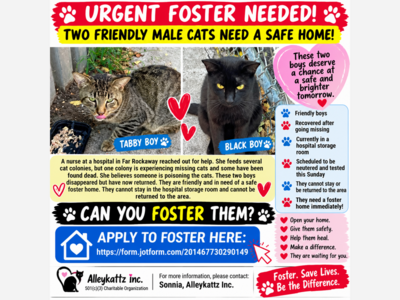
- Urgent Foster Homes Needed for Two Rescued Cats Amid Reports of Missing and Dead Cats in Far Rockaway Alleykattz Inc. appeals for immediate help after a hospital worker reports disturbing conditions affecting a local cat colony. Two friendly male cats need a safe place to go.
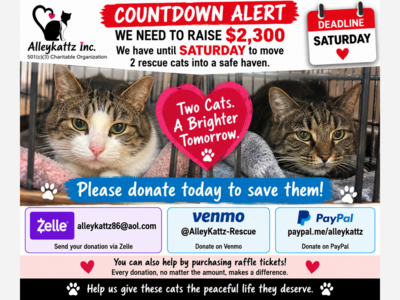
- Urgent Countdown: Alleykattz Inc. Seeks $2,165 to Move Two Feral Cats to Safety Before Saturday Deadline Animal rescue organization appeals for community donations to help relocate two feral cats to a safe haven.